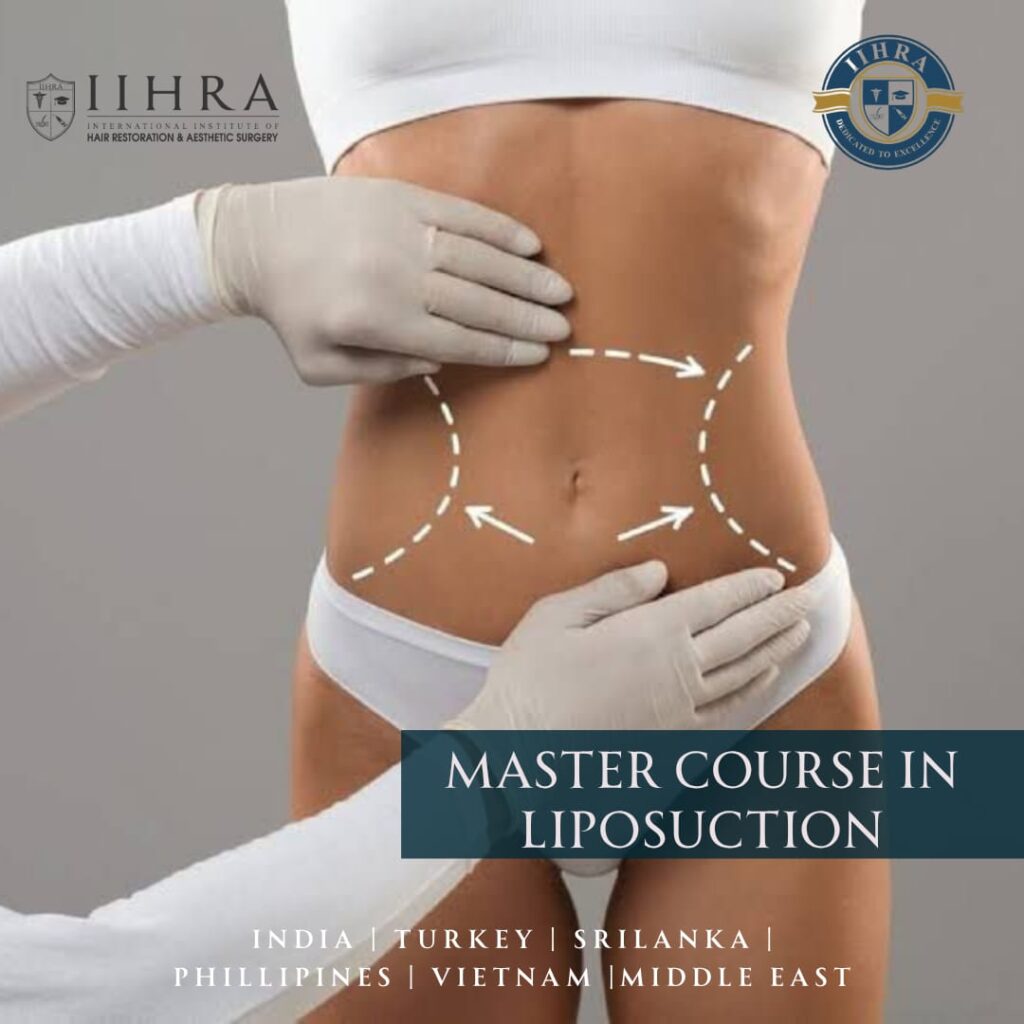
Master Course in Advanced Liposuction & Body Contouring
Comprehensive 2-Day Advanced Surgical & Hands-On Fellowship Program
- University Affiliation: Northwest International University (NIU) Affiliated Program
- Global Accreditation: Continuing Professional Development (CPD) Certified – UK CPD Approved
- Course Duration: 2 Days (Advanced Surgical Immersion)
- Instruction Format: Interactive Core Lectures, High-Definition Live Operating Room Demonstrations, & Supervised Hands-on Surgical Residency
- Minimum Eligibility: Strictly open to licensed Medical Practitioners specializing in Plastic Surgery, General Surgery, Dermatology, or equivalent advanced surgical disciplines.
This postgraduate-level surgical masterclass delivers an exhaustive, high-yield foundation in tumescent anesthesia fluid dynamics, mechanical adipose debulking, and high-definition body sculpting. Led by an esteemed international faculty, the program transitions qualified surgeons into the definitive subcutaneous planes required to safely perform fat extraction while minimizing contour irregularities and ensuring strict systemic patient safety.
Focus: Subcutaneous Anatomy, Klein’s Tumescent Formula, Cannula Selection Dynamics, and Vector Mapping
Module 1: Surgical Anatomy & Subcutaneous Tissue Layering
- Surgical Layering: High-resolution analysis of the subcutaneous fat architecture (Superficial Fat Layer, Scarpa’s Fascia, and Deep Fat Layer) across primary target zones (Abdomen, Flanks, Thighs, and Arms).
- Vascular Mapping & Hemostasis: Detailed charting of the superficial epigastric, circumflex iliac, and subdermal vascular plexus networks to prevent intraoperative hemorrhage or post-surgical seromas.
- Nerve Architecture: Tracking safe vectors and depth parameters around regional sensory nerves to minimize chronic postoperative paresthesia or localized numbness.
Module 2: The Liposuction Consultation & Pre-Surgical Mapping
- Patient Selection & Safety Thresholds: Evaluating body mass index (BMI) limits, skin elasticity metrics, and identifying ideal fat extraction candidates vs. loose skin excisional indications. Managing patient expectations and identifying Body Dysmorphic Disorder (BDD) clinical risks.
- Topographic Vector Mapping: Designing concentric ring grids on live models using demographic instruments to distinguish deep fat deposits from superficial transition zones.
- Photographic Standards: High-resolution boundary documentation, standardized profiling angles, and establishing legal medical consent document logs.
Module 3: Surgical Pharmacology, Tumescence, & Fluid Dynamics
- Klein’s Tumescent Formula: Core pharmacology of Lidocaine and Epinephrine combinations, calculating precise milligram-per-kilogram safe dosages (up to $35\text{ mg/kg}$ to $55\text{ mg/kg}$ limits), and recognizing toxicity (LAST – Local Anesthetic Systemic Toxicity).
- Fluid Dynamics Calculations: Mastering the Wet, Super-Wet, and Tumescent infiltration techniques. Calculating input-to-output fluid ratios to prevent systemic fluid overload or hypovolemic shock.
Module 4: Device Technology & Cannula Dynamics
- Energy-Based Platforms: Comparative analysis of Manual Suction-Assisted Liposuction (SAL), Power-Assisted Liposuction (PAL), Ultrasound-Assisted Liposuction (UAL/Vaser), and Laser-Assisted Liposuction (LAL).
- Cannula Engineering: Selection criteria for harvesting vs. contouring cannulas. Understanding punch geometry (Mercedes, Basket, Triport), diameters ($2\text{ mm}$ to $4\text{ mm}$), and cross-criss-crossing vector rules to eliminate superficial dimpling or “tunneling” defects.
Focus: Live Operating Room Case, High-Dose Complication Protocols, and Post-Op Continuity
Module 5: Pre-Operative Preparation & Theater Stabilization
- Clinical Protocol: Live patient standing marking with demographic instruments under international faculty supervision. Mapping the access incisional ports, defining structural fat zones, and establishing strict sterile fields.
Module 6: Live Surgical Execution – Case 1 (High-Volume Abdominal & Flank Liposuction)
- Tumescent Infiltration: Supervised real-tissue deployment of high-definition tumescent fluid using specialized infiltration pumps, ensuring even tissue turgor.
- Cannula Manipulation & Fat Extraction: Live surgical execution of cross-criss-crossing cannula tracking. Mastering the non-dominant hand “pinch test” to gauge remaining fat layer thickness under direct international faculty supervision.
- Port Care & Immediate Closure: Supervised hands-on clearing of remaining fluid (milking the ports), open vs. closed port protocols, and micro-suturing.
Module 7: Comprehensive Complications Management & Emergency Protocols
- Systemic Crisis Control: Algorithmic recognition and immediate intervention for Lidocaine toxicity (LAST), Fat Embolism Syndrome (FES), and deep vein thrombosis (DVT/PE prophylaxis).
- Local Contour Deformity Reversal: Surgical corrective strategies for postoperative waves, valleys, saucer deformities, skin hyperpigmentation, and chronic seroma pockets.
- Subdermal Thermal Burns: Prevention and management workflows for energy-based device over-heating or skin flap ischemia.
Module 8: Post-Surgical Continuity & Compression Garment Therapy
- The First 24–48 Hours: Post-operative drainage monitoring, fluid balancing logs, and early ambulation protocols.
- Compression Vest/Garment Metrics: Step-by-step guidance on applying first-stage and second-stage medical compression garments and foam inserts to prevent dead-space accumulation and maximize skin redraping outcomes.
- Grand Final Review: Interactive clinical panel with international mentors, practice integration frameworks, and the distribution of Master Course Certifications from Northwest International University & UK CPD.